You see many factors that influence the roof sheet roll forming machine price. These factors include the complexity of the machine, the quality of materials and parts, the tooling, the speed of operation, the level of automation, the thickness and width of the sheets it can produce, the control systems, and whether you want it customized.
One significant issue for buyers is that advanced roll forming machines come with a high initial cost. New machines equipped with computer control, auto feeding, and other automated features require a substantial investment. In some cases, the price can reach millions of dollars.
Understanding these factors helps you make better choices. The following sections will explain each aspect in more detail.
Key Takeaways
Machine complexity changes the price. More features and automation make machines cost more. These features help machines work better and faster.
Pick strong materials for longer use. Good materials last longer and need fewer repairs. This saves money over time.
Think about how fast and automatic the machine is. Faster machines cost more at first. They can lower labor costs and make more products.
Look at customization choices closely. Custom machines fit your needs better. They cost more at the start.
Check both price and how well the machine works. Cheaper machines may not have many features or good support. Expensive machines often have better quality and service.
Key Cost Factors
Machine Design Complexity
The way a machine is designed affects its price a lot. Bigger machines use more materials and need special skills to build. This makes them cost more. If you pick a machine with more automation, you will pay extra. But it will work faster and better. Some machines have computer controllers or notching. Others have variable frequency drives. These features make the machine more expensive. They also help you make roof panels quickly and with good quality.
Here is a table that explains how design complexity changes the cost:
Factor | Explanation |
Machine Size and Dimensions | Bigger machines need more materials and special skills, so they cost more. |
Material Quality and Durability | Better parts cost more but last longer and need less fixing. |
Automation and Technology | More automation makes the machine faster, but also pricier. |
You can look at which design features make the price go up:
Design Feature | Impact on Price |
Specialized Shears | Makes cutting faster and more exact, so it costs more |
High Speed Production | Lets you make more panels, so it costs more |
Computer Controller | Lets you do more things, so it adds value |
Single or Double-Deck | Gives more choices, so it can cost more |
Accuracy Features | Makes sure panels are always good, so price goes up |
Notching Feature | Lets you do more jobs, so it may cost more |
Variable Frequency Drive (VFD) | Makes the machine run better, so it costs more |
Tip: Machines with more features cost more money. Think about which features you really need before you buy.
Material and Component Quality
When you look at different machines, check what they are made of. Machines made from strong steel, aluminum, or copper last longer. They also break less often. If you buy a machine with better materials, it costs more at first. But you save money later because it works well for a long time.
Here is a table that lists common materials used in these machines:
Material Type | Gauge/Thickness | Notes |
Steel | 30 gauge to 24 gauge (.3mm to .6mm) | Painted, galvanized, aluminized |
Aluminum | .019" to .032" (.5mm to .8mm) |
|
Copper | 16 oz. to 20 oz. 3/4 Hard (.5mm to .7mm) |
|
You should ask where the materials come from and how good they are. Some brands use better parts to make the machine last longer and work better. This is a big reason why some machines cost more.
Tooling and Roll Stand Count
The tools and number of roll stands change the price and how well the machine works. If a machine has more roll stands, it shapes metal better and can make more panels. Machines with special tools cost more. But they let you make harder shapes and use thicker metal.
Here is a table that shows how roll stand count changes what the machine can do:
Specification | Value |
Number Of Forming Stations | 18 stand |
Production Capacity (meters/min) | 25 mtr per min |
Job Thickness | 0.25mm to 0.8mm |
Power | 20 HP |
Max Sheet Width | 1220 |
There is a big price gap between simple machines and fancy ones with more tools:
Machine Type | Price Range |
Entry-Level | $10,000 - $30,000 |
Mid-Range | $30,000 - $100,000 |
High-End | $100,000 and above |
Note: If you want to make lots of panels or special shapes, you need better tools and more roll stands. This costs more at first, but you get better work and save time.
Specifications Impacting Roof Sheet Roll Forming Machine Price
Speed and Automation
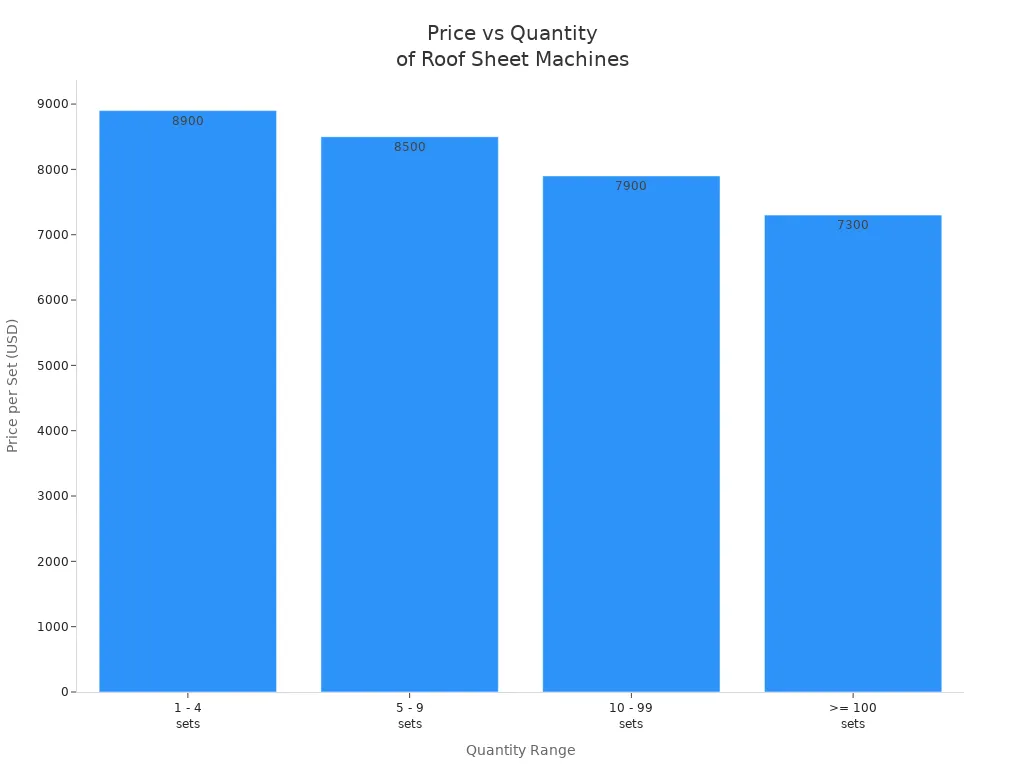
When you compare machines, look at how fast they work. Faster machines usually cost more money. They help you make more roof panels in less time. If you want a high-speed machine, you will pay more. For example, one high-speed machine can cost $10,500. If you buy more machines, the price for each one goes down.
Quantity Range | Price per Set |
1 - 4 sets | $8,900 |
5 - 9 sets | $8,500 |
10 - 99 sets | $7,900 |
>= 100 sets | $7,300 |
Automation also changes the price. Machines with more automation cost more at first. But they work faster and need less help from people. This means you spend less on workers. You also make fewer mistakes. Over time, you save money because the machine does more work.
Faster machines cost more.
More automation means you pay more at first but save later.
You need fewer workers and get better results.
Tip: Pick the speed and automation that fits your needs. This helps you spend your money wisely.
Thickness and Width Capacity
How thick and wide the machine can make sheets changes the price. Machines that work with thicker or wider sheets need stronger parts. This makes them cost more. Always check what the machine can do before you buy it.
Factor | Explanation |
Machine Size and Capacity | Bigger machines that make more panels need more parts, so they cost more. |
Complexity of Design | Fancy features and hard designs make the machine cost more to build. |
Quality of Materials | Better materials and strong parts last longer, so they cost more. |
Customization Options | Special machines need extra work to make, so they cost more. |
If you want a machine that makes many types of panels, it will cost more. But you get better quality and the machine lasts longer. Ask the company which machine is best for you.
Control Systems
Control systems are important for the price of these machines. Advanced systems like PLC control make the machine easier to use. You can change the speed, count panels, and start or stop the machine by itself. These features help the machine work better.
PLC control systems help the machine run by itself.
AC frequency speed lets you change how fast the machine goes.
Easy controls mean workers learn faster.
Auto start/stop and counting make work quicker.
With better control systems, you get better results. Workers do not need as much training. You get more work done. Good control systems make your machine worth more money.
Factors Affecting Roofing Roll Forming Machine Price
Material Costs
Material costs are a big part of the machine price. The metal you pick, like steel, aluminum, or copper, changes what you pay. Steel is used a lot, but its price can change. The grade of metal matters too. Better grades last longer but cost more. How thick and big the metal coil is also changes the price. If you buy many coils at once, each one may cost less. Extra things like painting or galvanizing make the price go up. Where you buy from and who sells it also matter. Money exchange rates can change the final price.
The metal type changes cost and quality.
Metal grade affects how long it lasts and price.
Market prices for metal can go up or down.
Thickness and size of coils change the price.
Buying more at once can lower the cost.
Painting or coating adds to the price.
Who sells it and where they are changes cost.
Money exchange rates can change what you pay.
Tip: Always look at metal prices before you buy a roof panel machine. This helps you plan your spending.
Customization Options
Customization lets you get a machine that fits your needs. If you want a special shape or your own logo, it will cost more. Machines with more features or that are harder to build cost extra. Well-known brands may charge more because people trust them.
Factor | Description |
Customization | Special features made for your work cost more. |
Complexity | Harder machines with more features cost extra. |
Manufacturer Reputation | Famous brands may cost more because people trust them. |
Pick the features that help your business most. Custom machines work better for you, but they cost more.
Accessories and Upgrades
Accessories and upgrades help your machine work better and last longer. You can add a touchscreen to make controls easier. A PLC computer controller helps you track jobs. Dual overhead reel stands hold bigger coils and save time. Run-out tables help you move finished panels. A hot melt sealant pump keeps panels water-tight. The EZ-Counter makes sure each panel is the right size.
Touchscreen makes fixing problems easier.
PLC controller helps you track jobs.
Dual reel stands make work faster.
Run-out tables help move panels.
Hot melt sealant pump keeps panels strong.
EZ-Counter makes panels the right length.
Adding upgrades costs more, but your machine works better and lasts longer. Check the price for each upgrade before you buy.
Note: Accessories and upgrades can make your machine better. Pick the ones that fit your needs and budget.
Comparing Roofing Roll Forming Machines by Cost
Manual vs. Automatic
There are big differences between manual and automatic machines. Manual machines cost less and have easy controls. You do not spend much money at first. But you need more workers to use them. These machines are good for small jobs or simple roof panels. If you want to spend less at the start, a manual machine can work for you.
Automatic machines cost a lot more money. You pay more, but they make panels faster. You do not need as many workers. These machines use special controls and automation. You can make more panels in less time. Over five years, you spend less on workers and get better panels. Big factories pick automatic machines for lots of work.
Here is a table to help you compare:
Machine Type | Price Range (USD) | Advantages | Best For |
Manual Roll Forming Machine | 15,000–40,000 | Low initial cost, simple to operate | Small-scale production, basic profiles |
Semi-Automatic Roll Forming Machine | 40,000–100,000 | Balanced cost & efficiency, reduced labor | Medium-scale operations, flexible production |
Fully Automatic Roll Forming Line | 150,000–500,000 | High-speed, minimal labor, advanced automation | Large-scale, high-volume production |
Tip: Think about what you need and how much you can spend. If you want your business to grow, an automatic machine can save you money later.
Price vs. Performance
You should not only look at the price when you pick a machine. Cheaper machines may look good, but they have fewer features. They also may not come with much help. Expensive machines work better and last longer. You get more help from the company. You also get better quality and fewer surprise costs.
Buyers often look at these things:
Factors Considered | Higher-Priced Machines | Lower-Priced Alternatives |
Upfront Costs | Higher | Lower |
Factory Warranty | Yes | Often No |
Support | Included | Limited |
Efficiency | Designed for maximum | Varies |
Future Expansion | Possible | Uncertain |
Hidden Costs | Fewer | Potentially High |
When you look at brands, check if people trust them. Ask if you get help after you buy. Get price quotes and compare what you get. A good machine works well and saves you money over time.
Note: Always think about cost, quality, and how well it works. The best machine is the one that fits your needs and plans.
When you look at roofing roll forming machines, think about these main costs: Machine price, Labor and material costs, Operational expenses, Energy efficiency, and Warranty and customer service. Check if the machine is built well. See if you get good help after you buy it. Think about how much it will cost to own the machine over time. Always learn about the company that makes the machine. Do not pick just because it is cheap. To buy the right machine, do these things: 1. Think about what materials and products you need. 2. Look at how fast and how much you want to make. 3. Make sure the machine is safe, good quality, and can grow with your business. > Tip: Use guides that show how strong the machine is, how much energy it uses, and how fast it works. This will help you choose.
FAQ
What affects the price of a roof sheet roll forming machine most?
The price changes a lot because of how the machine is made. If the machine is fast or has smart controls, it costs more. Special features also make the price go up.
How do you choose between manual and automatic machines?
Manual machines are cheaper and good for small jobs. Automatic machines are faster and need fewer workers. Pick the one that fits your work and how much you want to spend.
Can you upgrade your machine later?
Most machines let you add new parts later. You can get things like touchscreens or PLC controllers. Ask the company what upgrades you can get before you buy.
What support do you get after buying a machine?
Many companies give training, spare parts, and help with problems. Check what kind of warranty and help you get before you buy. Good support helps you save time and money.