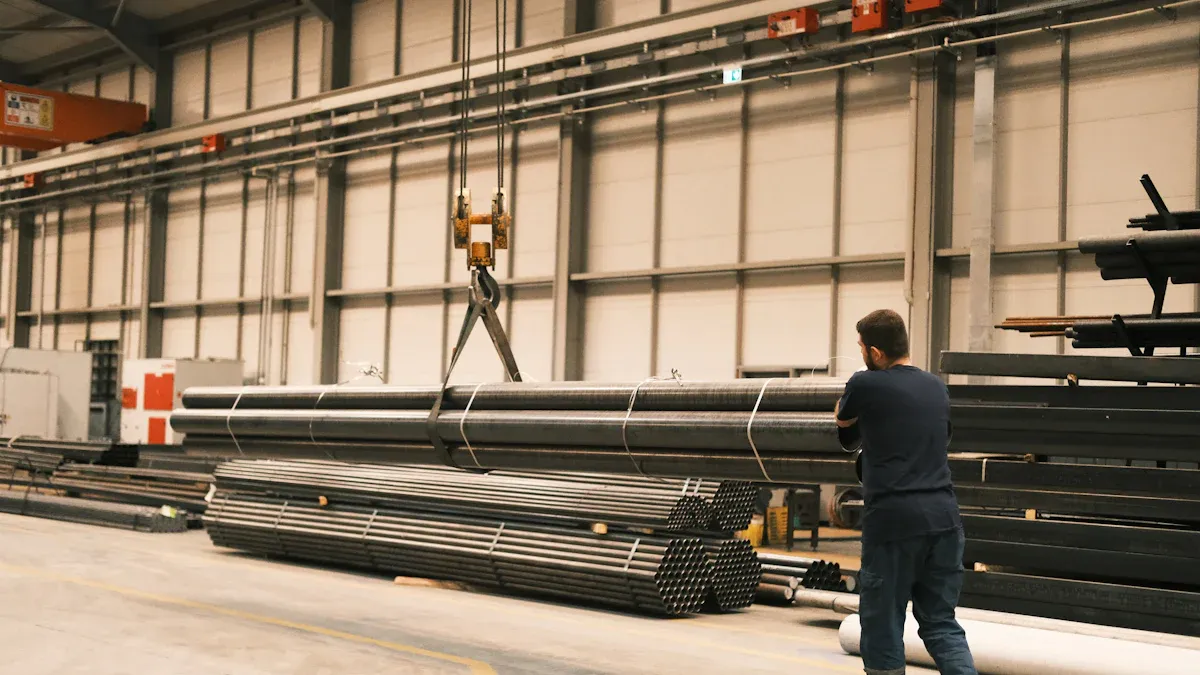
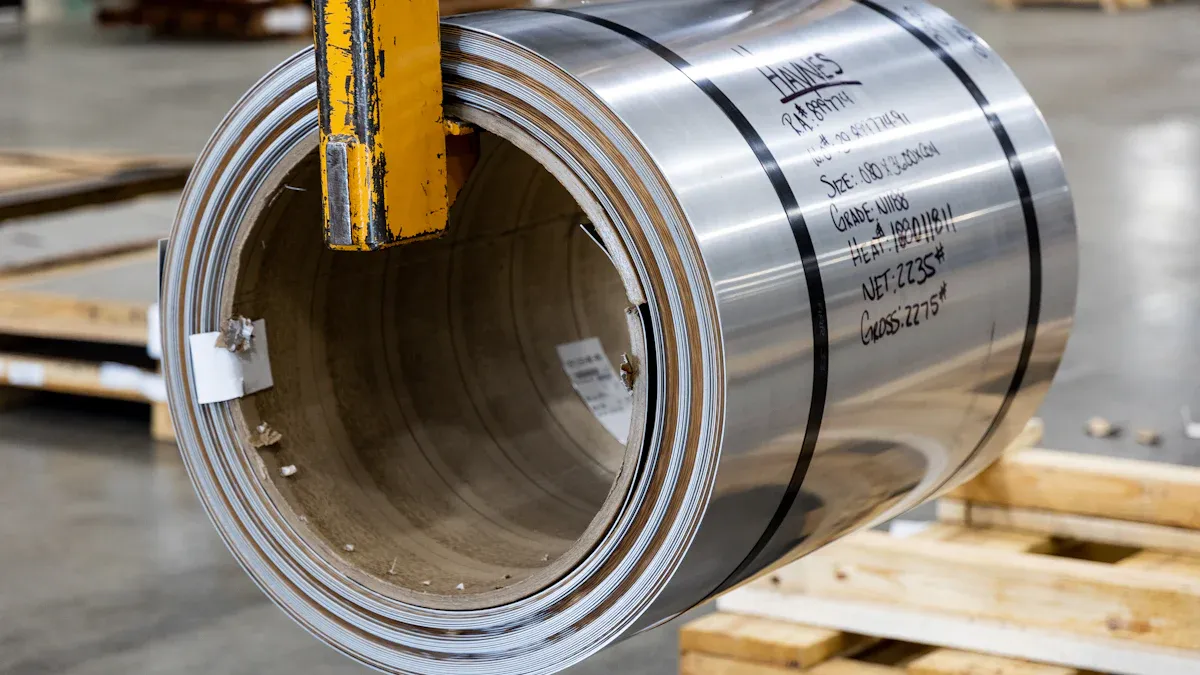
Selecting the right coil for your roll former is important. You need to match coil width, thickness, and quality to your machine. If you use a metal coil with uneven thickness, you may have problems. Poor consistency can cause twisting, bowing, or cracks in your product. These problems can make your machine wear out faster. They can also cause expensive mistakes. Always check that the coil specs fit your roll former. Make sure your supplier is reliable too.
Key Takeaways
Make sure the steel coil’s width, thickness, and grade fit your roll former. This helps stop machine damage and product mistakes.
Pick the right steel substrate and coating for your project’s environment. This helps your product last longer and keeps it from rusting.
Use coils with tight tolerances for a better fit and less waste. This makes production smoother and saves time and money.
Work with suppliers who have lots of experience. They should offer quality control, deliver on time, and give good technical help. This keeps your project running well.
Think about price, quality, and service together. The cheapest coil can lead to more repairs and lost time. Choose carefully to get the best value.
Roll Former Requirements
Width & Thickness
When picking a metal coil, look at its width and thickness. The coil must fit inside your machine’s guides. Most machines use coils from 1 inch to 20 inches wide. Some can use coils up to 54 inches wide. For example, 29 gauge steel coils are about 40.875 inches wide. Thicker 26 gauge coils can be 41.5625 or 43 inches wide. Always measure your machine’s guides before you buy a coil.
The thickness of the coil is important too. Most roll formers use coils from 0.012 inches to 0.200 inches thick. Some machines can use thinner or thicker coils, but you need to check your machine’s limits. Portable roof panel roll formers use coils from 28 gauge to 22 gauge. If you use a coil that is too thick or wide, you could break your roll former or lose your warranty.
Tip: Always read your machine’s manual to know the right coil width and thickness. Using the wrong size can break your machine or ruin your product.
If the coil’s width or thickness changes, you can have problems. Uneven thickness can cause twisting, bowing, or cracks in your product. If the width changes, especially at the edges, you can get defects. The metal may not cool the same everywhere. This can make the ends of the coil weaker or thinner, even if the rest is fine.
Machine Limits
Your roll former has rules for what coils it can use. These rules include the biggest and smallest coil width, thickness, and weight. If you use a coil outside these rules, you can break your machine or make bad parts. Some machines only use coils up to 30 inches wide. Others can use coils up to 80 inches wide. Always check your machine’s specs for the right coil width and thickness.
You also need to think about the material’s properties. Thicker and stiffer metal needs bigger roll shafts and more power. If the coil is too strong or thick, your roll former may not shape it. This can wear out your machine, cause downtime, or even be unsafe.
Steel Grades
The steel grade you pick changes how your roll former shapes the coil. Different steel grades have different strengths and how much they can stretch or bend. You need a steel grade that fits your machine and your product.
Some steel grades, like advanced high-strength steels, need more force and special tools. These steels have complex structures that change how they bend. Steels with a high yield-to-tensile strength ratio are better for straight parts. Lower-strength steels bend easier and do not crack as much.
Note: Always pick a steel grade your roll former can handle. Using the wrong grade can cause springback, cracks, or bends that are not even.
It is also important that the coil has tight tolerances. Precision coils with exact width, thickness, and strength help your roll former make even parts. Loose tolerances can make setup take longer, waste more metal, and stop your machine. Precision coils help your work go smoother and make your products better.
Metal Coil Specs
Substrate Types
You must pick the right substrate for your metal coil. The substrate is the main metal before any coating is added. Each type has special features. These features change how your roll former shapes the metal. They also affect how long your product lasts. The three most common substrates are Galvalume®, galvanized steel, and cold-rolled steel.
Here is a table that shows the main differences:
Attribute | Galvalume Steel | Galvanized Steel | Cold-Rolled Steel Substrate |
Coating Composition | Aluminum (55%), Zinc (43.4%), Silicone (1.6%) alloy | Zinc only | N/A |
Corrosion Resistance | Superior, self-healing coating | Good initially, but prone to red rust once exposed | N/A |
Longevity | 40+ years | 15-20 years | N/A |
Warranty Availability | Often offered (paint, substrate, weathertight) | Generally no substrate warranties | N/A |
Formability | Less malleable, more prone to cracking during bends | More malleable, better for precise bends | N/A |
Typical Applications | Roofing, walls, commercial, residential, industrial | Agricultural (animal confinement), fencing, HVAC | N/A |
Price Range | Mid-level, fluctuates but generally competitive | Similar or sometimes higher than Galvalume | N/A |
Special Considerations | Not suitable near copper, lead, treated lumber; scuffing concerns on unpainted panels | Better suited for animal confinement due to ammonia resistance | N/A |
Oil Canning | Susceptible | Susceptible | N/A |
Galvalume® metal coil is strong against rust and lasts a long time. Its aluminum-zinc coating protects the steel and can heal small cuts. Galvanized metal coil has a zinc coating. It stops rust at first but can get red rust if scratched. Cold-rolled steel is not used as much because it has no coating. You must add paint or a finish to stop rust.
The substrate you choose changes how your metal coil works. Galvalume® is good for roofs and wall panels. Galvanized metal coil is better for barns and fences. Cold-rolled steel is best inside or if you want to paint it.
Tip: Always pick a substrate that fits your project and where it will be used. Galvalume® lasts longer outside, but galvanized metal coil is better if there is ammonia.
Coatings & Finish
The coating and finish on your metal coil protect it from rust, scratches, and chemicals. There are many types of coatings. Each one gives your metal coil special benefits.
Abrasion resistant coatings help stop scratches and wear.
Anti-corrosion coatings keep rust away and make coils last longer.
Acid resistant coatings protect in places with harsh chemicals.
Chemical resistant coatings shield from spills and fumes.
Impact resistant coatings make coils tougher against dents.
Mar resistant coatings keep coils smooth and clean.
Acrylic coil coatings add shine and block UV rays.
Polyester coil coatings give color and weather protection.
Silicone-modified polyester coatings make coils stronger and more flexible.
Epoxy phenolic linings add extra chemical resistance.
The type and thickness of the coating change how your coil works over time. Thick coatings like G90 galvanized protect better but can crack if bent too much. Thin coatings like G40 or G60 bend easier but do not last as long. Primer coatings like red oxide need more topcoats and care. Galvanized coatings can last over 40 years in tough places. Primer coatings last about 20 years and need more work.
Here is a table that compares coating types:
Aspect | Galvanized Coatings (e.g., G60, G90) | Red Oxide Primer Coatings |
Corrosion Protection | Superior due to zinc barrier and sacrificial anode effect; service life often exceeds 40 years | Moderate; primer offers barrier but shorter service life (~20 years), requires multi-layer topcoats |
Coating Thickness | Thicker coatings (G90+) enhance corrosion resistance but reduce formability, increasing risk of cracking on tight bends; thinner coatings (G40, G60) improve formability but offer less protection | Generally thinner; care needed to avoid cracking, chipping, or delamination during roll forming; warm roll forming may improve formability |
Formability | Slightly reduced with thicker coatings due to hardness of zinc-iron alloy layers; risk of cracking on tight bends | Requires careful handling; paint film ductility and adhesion critical; pre-flattening may be needed, adding labor |
Maintenance | Low maintenance due to durable zinc protection | Higher maintenance; needs complete topcoat system and more frequent upkeep, especially in harsh environments |
Service Life | Typically over 40 years, especially in structural cold-formed steel framing | Around 20 years, depending on environment and topcoat quality |
Environmental Suitability | Preferred for harsh, humid, coastal, or industrial environments | Suitable for controlled, dry, interior environments or where cost is a primary concern |
Lifecycle Cost | Higher initial cost offset by longer service life and lower maintenance | Lower initial cost but potentially higher lifecycle cost due to maintenance and shorter lifespan |
Additional Notes | Can be painted but requires surface prep; welding requires fume control; highly recyclable | Designed for painting; welding may affect primer; improving formulations with low VOCs |
Pick a coating that matches where your coil will be used. If your coil will be outside or near saltwater, use a thick anti-corrosion coating. If you want a bright color or smooth look, pick polyester or acrylic. Always check the coating type and thickness before you buy.
Tolerances
Tolerances are the allowed differences in thickness, width, and shape. Tight tolerances help your roll former make parts that fit well. Loose tolerances can cause gaps, twists, or wasted metal.
Here are the typical tolerances for steel coils:
Parameter | Typical Tolerance | Notes |
Cross-section dimensions | ± 1/64 inch (~±0.0156 inch) | Commonly applied tolerance |
Angles | ± 1° to 2° | Typical angular tolerance |
Closer tolerances | ± 0.005 inch | Achievable with additional tooling, tryout time, and possibly premium material |
Effects of thickness range | Rolls fitted for max thickness | Operator adjusts roll gap vertically to accommodate thickness variations |
Width variations | Affect leg length in formed parts | Width variation impacts section tolerance |
Straightness considerations | Camber, sweep, twist | Camber/sweep ~1/8" to 1/4" in 10'; twist ~5° to 15° in 10' |
Parameter | Range / Tolerance | Units |
Thickness Range | 0.0003" to 0.125" | inches (0.0076mm–3.175mm) |
Thickness Tolerance | ±3% standard; ±1% extreme | percentage |
Width Range | 0.020" to 14" | inches (0.508mm–356mm) |
Width Tolerance | ±0.005" | inches (±0.127mm) |
Tight tolerances give you many good things:
Coil slitting lets you pick the right width and thickness.
Tight tolerances help you use more of your metal and waste less.
Exact slit widths mean you do not need extra work, so you save money.
Even widths and smooth edges make your product look and work better.
Some industries, like cars and planes, need tight tolerances for safety.
You need skilled workers and good tools to keep tight tolerances. If your coil has uneven thickness or width, you will get more scrap and lower quality. Always ask your supplier for the tightest tolerances you can afford.
Note: Tight tolerances help you make better products and waste less. This saves you money and keeps your customers happy.
Project Needs
End-Use
Start by thinking about how you will use the metal coil. The final use tells you which material and coil specs are best. For example, metal roofing for homes needs a coil that does not rust and is easy to shape. If you need a part for heavy equipment, you may want a stronger metal. Here are some things to think about:
Pick a steel grade that fits how you will shape it, like how deep you need to draw, if it will spring back, and if you need to weld it.
Think about the steps in making the coil. Hot rolling, pickling, cold rolling, and slitting change how strong and smooth the coil is.
Choose a coil form and package that works with your machines. Pancake or oscillate wound coils can help your work go faster.
Balance the cost with how strong, rust-proof, and tough the coil is. Some jobs need the coil to resist dents or have spring temper.
Make sure the coil meets quality rules like ASTM or ISO.
If you want to use the coil for metal roofing, see if the supplier has custom choices for your job. You might need a special coating or a certain size.
Aesthetics
How your metal looks is important, especially for buildings. You can pick from many finishes and coatings to get the look you want. Suppliers have matte, brushed, or shiny mirror finishes. Special coatings can give solid colors, woodgrain, or shiny metal looks. Here is a table with common finishes:
Surface Finish | Description | Aesthetic Impact | Typical Use in Architecture |
No. 2B (Matte) | Smooth, dull | Least shiny | Flashings, hidden parts |
No. 4 (Brushed) | Shiny, brushed | Looks nice | Facades, visible parts |
No. 8 (Mirror) | Very shiny | Fancy look | Decorative panels |
The coil’s quality changes how your metal roof looks as time goes on. Problems like chalking, fading, and oil canning can make your product look worse. Good coatings like PVDF keep colors bright and safe from weather. You can also ask for special colors or textures to match your design.
Tip: Pick a coil with a finish and coating that match your project’s style and where it will be used. Special coatings can make your product look better and last longer.
Durability
Durability is very important for metal roofs or custom metal jobs. You want a coil that stays strong and lasts a long time. The right material and coating stop rust, dents, and fading. Always check the warranty before you buy. Good warranties for paint, substrate, and weathertightness mean the coil and supplier can be trusted.
Look for clear warranty papers that tell you what is covered and for how long.
Strong coatings like PVDF keep color and protect for many years.
Cheap materials often do not have good warranties and break sooner.
A good warranty keeps your money and your name safe.
Pick a coil that fits your project’s needs for strength and lasting power. Custom choices let you get the best material and coating for your area.
Supplier Choice
Experience
When you choose a coil supplier, look for real experience in roll forming. Some suppliers only sell metal, but others run roll forming machines every day. These suppliers know how a coil should behave in your machine. They understand the problems that can happen if the coil is not right. You want a coil supplier who has worked on projects like yours and can give advice when you need it.
A good coil supplier will:
Show a strong track record with similar roll forming jobs.
Offer custom solutions for your project.
Have enough production space to meet your deadlines.
Provide helpful customer support and clear answers to your questions.
Tip: Ask your coil supplier for references from other customers. This helps you see if they deliver quality and keep their promises.
Quality Control
Quality matters at every step. The best coil suppliers use strict checks to make sure every coil meets your needs. They measure width and thickness with special tools. They look for surface problems like waves or bent edges. If they find a problem, they fix it before the coil reaches you. Some suppliers even test how the metal bends to spot hidden issues.
You should expect your coil supplier to:
Provide Material Test Reports that show the coil’s chemical and mechanical properties.
Follow international standards like ISO 9001 for quality.
Inspect every coil for defects before shipping.
If you get a coil that does not match your order, do not adjust your machine. Send it back to your coil supplier. This keeps your equipment safe and protects your product quality.
Delivery
Fast and safe delivery keeps your project on track. A reliable coil supplier uses smart packaging to protect your coil from damage. They track inventory and manage shipping so you do not run out of material. Good delivery practices help you avoid delays and extra costs.
You can ask your coil supplier about:
How they package and label each coil.
Their average delivery times.
What happens if a delivery is late or a coil is damaged.
Note: A coil supplier with strong delivery and support can help you handle custom orders and keep your project moving.
Cost & Support
Pricing
You want to get the best value when you buy steel coils for your roll former. Price matters, but you should balance it with quality and service. Steel coil prices can change based on type, thickness, and where you buy. Here is a table to help you compare average prices for 2025:
Steel Coil Type | Price Range (per net ton) | Average Price (per ton) | Location |
Galvalume Coil (SMU) | $1,180 - $1,220 | $1,200 | FOB mill, east of Rockies |
Galvalume .0142” AZ50, Grade 80 | $1,471 - $1,511 | $1,491 | FOB mill, east of Rockies |
Flat cold-rolled steel coils <0.5mm | $1,262 | $1,262 | Northern America |
Flat cold-rolled steel coils 0.5-1mm | $1,131 | $1,131 | Northern America |
Flat cold-rolled steel coils 1-3mm | $1,113 | $1,113 | Northern America |
Global prices in 2024 ranged from $600 to over $1,100 per ton. In 2025, you can expect prices to stay in this range, depending on grade and region. Always ask your supplier for a clear quote and check what is included.
Tip: The lowest price does not always mean the best deal. Make sure you get good quality and support for your money.
Lead Time
Lead time is how long you wait for your steel coil to arrive. If your supplier has the coil in stock, you might get it the same day. If you need special slitting or cutting, you may wait about seven days. Some mills offer lead times as short as three to five weeks for hot-rolled or galvanized coils.
Lead time can change based on stock and if the coil needs to move from another branch. You should talk with your supplier to know the exact timing. When lead times change, your production can slow down. You might face downtime, higher costs, or delays for your customers. Long waits can also cause inventory to pile up and tie up your money.
Plan ahead and keep in touch with your supplier to avoid problems.
Technical Help
Good technical support helps you solve problems fast. You should look for suppliers who offer:
Online guides and answers for product and machine questions
Troubleshooting help, including remote support tools
On-site service for repairs and setup
Training for your team to use machines better
Clear repair and maintenance programs
Access to helpful resources like whitepapers and software
Note: Responsive technical support and clear communication can save you time and money. Choose a supplier who stands by you before and after the sale.
To pick the best steel coil for your roll former, do these things:
Decide which profiles you need for your project. Check if you want engineered or non-engineered panels.
Ask your supplier about the color and paint type. Make sure you know what warranty comes with it.
Make sure the coil size fits your machine and setup.
Tell your supplier the finished panel widths you need. This helps them cut the coil right.
Look at the material quality so you do not get defects.
Figure out how many coils you need for your job.
Work with your supplier to plan lead times and any special options.
Always make sure the coil specs fit your machine and project. Good suppliers and strong technical help keep you from making expensive mistakes. For hard jobs, use a checklist or ask an expert for help.
FAQ
What is the most important factor when choosing a steel coil for my roll former?
You need to match the coil’s width, thickness, and grade to your machine. This helps you avoid damage and defects. Always check your machine’s manual before you buy.
How do I know if a coil will fit my roll former?
Measure your machine’s guides and compare them to the coil’s width and thickness. Ask your supplier for exact coil specs. If you are unsure, request a sample.
Why do tolerances matter in steel coils?
Tight tolerances help you make parts that fit well. Loose tolerances can cause gaps, twists, or wasted metal. You save money and time with precise coils.
Tip: Always ask your supplier for the tightest tolerances you can afford.
What coating should I choose for outdoor projects?
Pick a coil with a thick anti-corrosion coating like G90 galvanized or PVDF paint. These coatings protect against rust and weather. Ask your supplier about warranty details.
Can I use any steel grade for my project?
No. You must choose a steel grade that matches your machine and your project’s needs. Some grades bend easier. Others resist rust better. Always check with your supplier.